The compound first synthesized in the late 1930's at Syntex, a small Mexican phamaceutical laboratory in Mexico City, norethindrone, is still the active ingredient in half of today's oral contraceptives. The compound was first synthesized from wild yams gathered in the jungle covered hills of southern Mexico. This discovery was also instrumental in enhancing the economical production of cortisone.
Mexican Wild Yams and Birth Control
Started by Roberto · Oct 4, 2012 · 11 replies
True story. One of the first progestins to be synthesized.
Oh no, I'll be having Organic Chemistry nightmares again! :shock:
Oh no, I'll be having Organic Chemistry nightmares again! :shock:
 |
|---|
| Systematic (IUPAC) name |
| (17β)-17-ethynyl-17-hydroxyestr-4-en-3-one; (8R,9S,10R,13S,14S,17S)-17-ethynyl-17-hydroxy-13-methyl-1,2,6,7,8,9,10,11,12,14,15,16-dodecahydrocyclopenta[a]phenanthren-3-one 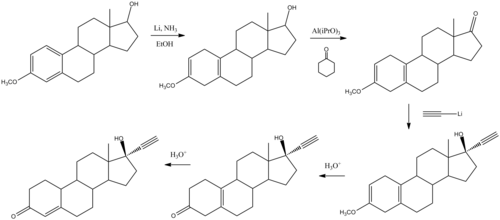 |


That's one of the reasons so many researchers are scrambling to do research on plants from the rainforest's for instance. We just might be ready to destroy plants that contain the secrets to the cure of many of mans diseases.
It's fascinating to think about how early humans found plants that were medicinal, what with no laboratory and rats to test stuff on! Course it looke like we have had a million years or so to check stuff out.
Some common drugs derived from rainforest plants are cortisone, quinine, and the "_caines".
Kenny said:That's one of the reasons so many researchers are scrambling to do research on plants from the rainforest's for instance. We just might be ready to destroy plants that contain the secrets to the cure of many of mans diseases.
Unfortunately, there's no incentive to find a cure for anything. Think about how much money the drug manufacturers and the insurance companies make on sick people. Since Dr. Salk found the cure for polio what else has been cured???????
mis2810 said:Unfortunately, there's no incentive to find a cure for anything. Think about how much money the drug manufacturers and the insurance companies make on sick people. Since Dr. Salk found the cure for polio what else has been cured???????
That profit motive cuts several ways for sure. Quinine is an example of a very important drug that did not get produced in volume and come to market because it could not be licensed and anyone could sell it. It's a good reason that the National Institute for Healh should be involved in medical research since it's for the good of all not just profit.
Enlighten this old guy. Am I right that quinine was/is used to fight malaria? Are there other uses for it?
I do know my father-in-law used if for leg cramps.
I was told he mixed it with gin, but I don't believe it. He was a scotch drinker, which probably dried him out,
ergo leg cramps.
I do know my father-in-law used if for leg cramps.
I was told he mixed it with gin, but I don't believe it. He was a scotch drinker, which probably dried him out,
ergo leg cramps.
Roberto said:It's fascinating to think about how early humans found plants that were medicinal, what with no laboratory and rats to test stuff on! Course it looke like we have had a million years or so to check stuff out.
But put a simple tomato in the hands of Europeans..History of Tomatoes
GV Jack said:Enlighten this old guy. Am I right that quinine was/is used to fight malaria? Are there other uses for it?
I do know my father-in-law used if for leg cramps.
I was told he mixed it with gin, but I don't believe it. He was a scotch drinker, which probably dried him out,
ergo leg cramps.
Yes, you are correct about use in malaria. It also has been used for leg cramps, but that use is unapproved by the FDA. Never been proven to be safe and effective for that use and around 2006 they ordered a bunch of quinine products off the market.
GV Jack said:Enlighten this old guy. Am I right that quinine was/is used to fight malaria? Are there other uses for it?
I do know my father-in-law used if for leg cramps.
I was told he mixed it with gin, but I don't believe it. He was a scotch drinker, which probably dried him out,
ergo leg cramps.
Yes malaria treatment, recorded as the first chemical treatment of a disease. Malaria is apparently still the most deadly disease worldwide. The real stuff was from the bark of a tree, synthetics developed during WWII due to a shortage of the bark. There is a story that the Brits had less malaria because the drank Gin and Tonic which tonic apparently contains quinine !! Don't know about the leg cramps, but hey it's a good excuse to drink !!
Found a nice simple little site.
Rainforest Plants Used for Medicine..Rainforest Plants Used for Medicine
And a green one..Tropical Rainforests - Nature’s Medicine Cabinet